The average plumbing business misses 28% of its calls, and 85% of the people who hit voicemail never ring back. They tap the next plumber on Google. How plumbers use AI assistants comes down to one decision: when you cannot pick up, something should. Here is what that actually looks like on a real job.
An AI assistant is software that answers your calls, texts, and chats when you cannot, captures the job details, books the appointment, and notifies you. The best ones do not replace you. They cover the gaps. For a working plumber, an AI assistant turns the call you would have missed under a sink into a booked job sitting in your inbox.
The call you miss is the job you lose
Picture a Tuesday. You are forty minutes into clearing a main line, both hands occupied, phone buzzing in your truck. That call is a homeowner with a water heater leaking into a finished basement. They need someone today. You do not hear it ring. By the time you wash up, they have already booked the plumber who answered on the second try.
This is not a rare event. It is the structure of the job. Home services businesses miss between 27% and 62% of inbound calls, and for a solo or small plumbing operation the number lands near the top of that range, because the person best at the work is the same person holding the wrench (AgentZap plumbing phone statistics, 2026). The average plumbing service call is worth about $375, and an after-hours emergency averages closer to $450 (HomeAdvisor service industry analysis, 2024 to 2025).
Now stack the after-hours problem on top. Roughly 62% of plumbing emergencies happen outside normal business hours, and weekend calls go unanswered at a 41% rate compared to 18% on weekdays. The calls most likely to be high-value emergencies are the exact calls least likely to get picked up.
This is the gap an AI assistant fills. Not the calls you can take. The ones you physically cannot.
What most plumbers get wrong about AI assistants
Here is the mistake: treating an AI assistant as a replacement receptionist that takes your customers off your hands. It is not that, and you do not want it to be. The plumbers who get the most out of this technology treat the AI as a safety net, not a substitute. You stay the person the customer reaches. The AI only steps in when you would otherwise have missed the call entirely.
That distinction matters because your relationship with the caller is the asset. A traditional answering service puts a stranger between you and your customer, types up a summary, and texts it to you hours later. You are one step removed from your own job. The better model keeps you in the conversation: the AI captures everything, and you decide what happens next.
The numbers that make this worth doing:
- Home service businesses miss an average of 27% of inbound calls, and small operations miss as many as 62% (call-tracking industry data, 2026).
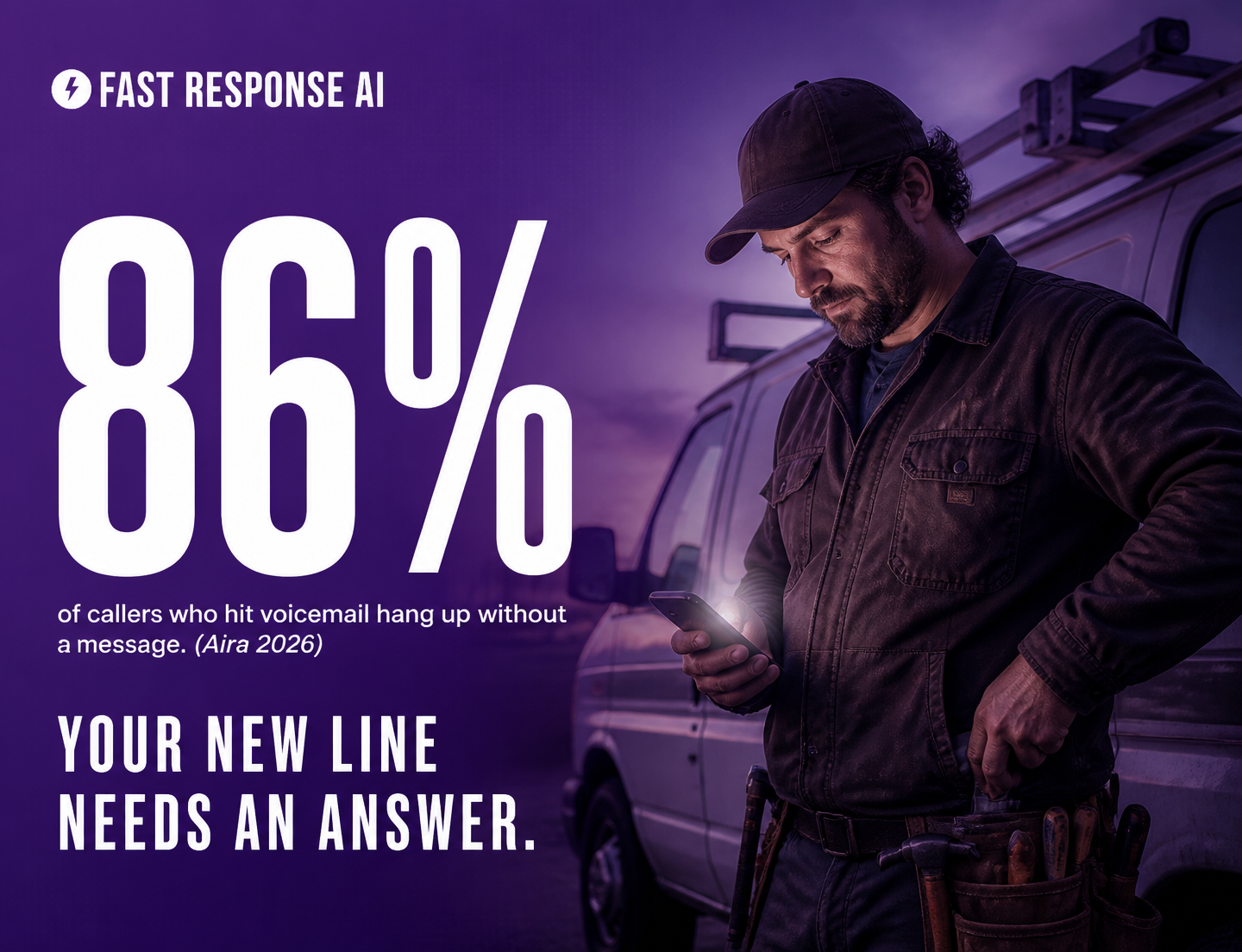
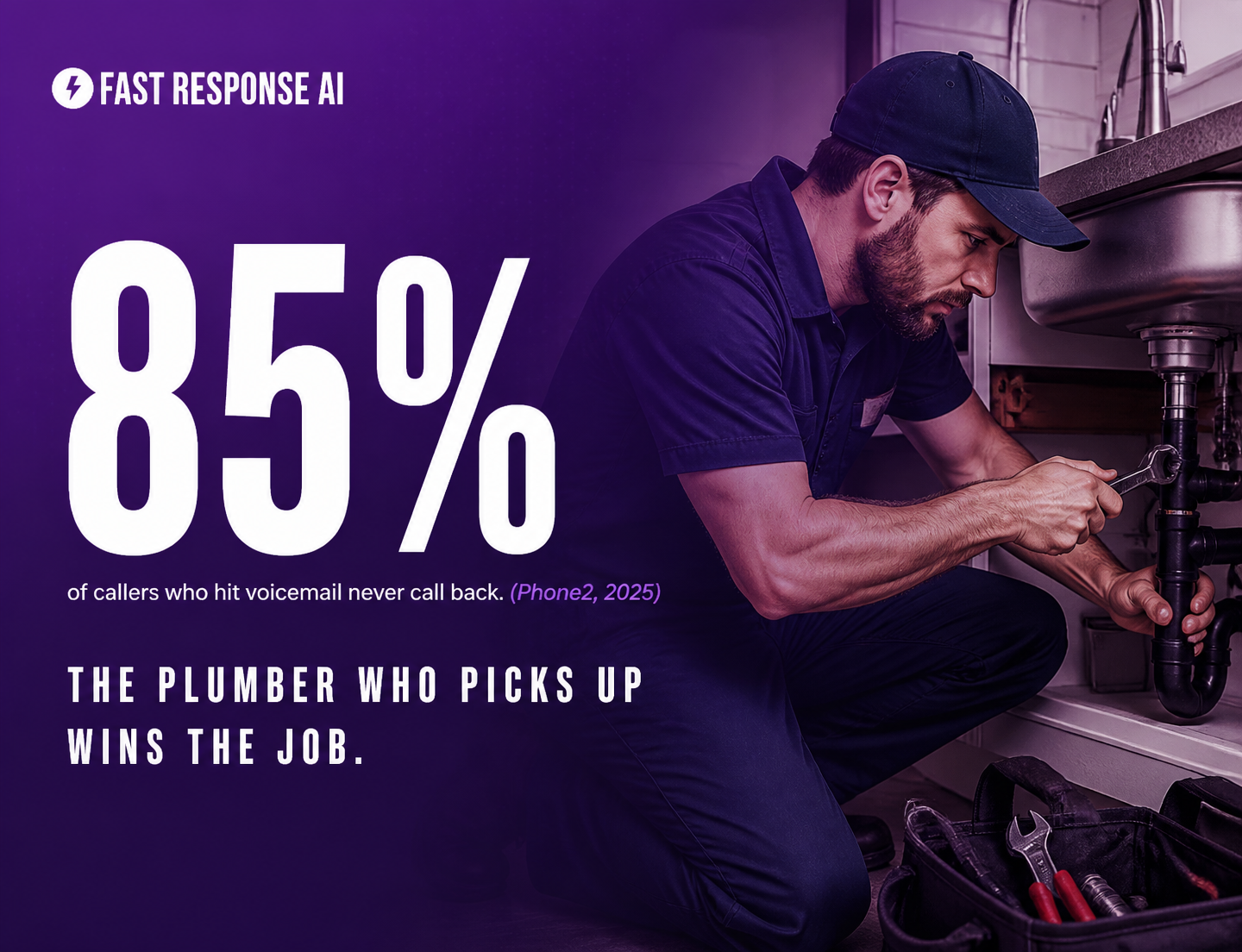
- 85% of callers who reach voicemail never call back, and 62% of them call a competitor instead (Phone2 benchmark, 2025).
- 78% of customers hire the first company that responds to them (business phone research, 2025).
- The average plumbing service call is worth about $375; an emergency call averages $450 (HomeAdvisor, 2024 to 2025).
- Missing just 3 calls a week can cost a contractor more than $58,000 a year in lost work.
- 35% to 40% of home services calls arrive after business hours, the window where missed-call rates are highest.
Read those again. The problem is not that you are bad at running a business. The problem is that the calls come while your hands are full, and voicemail does not save the lead. It buries it.
How the plumbers who win the after-hours job actually do it
The plumbers who stopped bleeding after-hours work did not hire a call center. They changed who answers when they cannot.
Think about the sprinkler repair operator who runs his whole business solo, or the trades operators who set this up themselves in under ten minutes with no onboarding call. The setup is simple: one inbox holds every call, text, and chat your business line receives. When you can pick up, you pick up, and you stay in the conversation like always. When you cannot, an AI assistant answers in your place so the caller is never dumped to voicemail. It asks what is wrong, gets the address, books the slot if your calendar allows, and drops the whole transcript into your inbox with a notification on your phone.
This is where a platform like Fast Response AI fits. It is not a service that intercepts your customers. It is your communications layer, branded as you, owned by you. You set the routing rule once: after 6pm, on weekends, or any time you do not answer within a few rings, the AI handles it. Every word is logged and searchable, so when you wrap up the main line and check your phone, the burst-pipe call is already there with the full conversation. You call the homeowner back yourself, and you sound like you were listening, because you were, just on your own schedule.
That is the shift. You stop being the operator who loses jobs to voicemail and become the one whose business always picks up. The customer relationship stays yours. The AI is the backup, not the front desk.
What to look for in an AI assistant for your plumbing business
Not every tool on the market works this way, so evaluate on the things that actually protect your business.
Look for one inbox that covers calls, texts, and chat, not a call-only bot, because homeowners text photos of the leak as often as they call. Look for routing rules you control, so you decide exactly when the AI takes over instead of handing your line to a vendor full time. Look for a full, searchable record of every interaction, which doubles as documentation for warranty and dispute questions later. Look for setup you can finish yourself in minutes without a sales call, and pricing that is flat and predictable rather than metered, so a busy night does not turn into a surprise bill. And confirm the AI captures and notifies rather than acting on its own: it should hand you the emergency, not make dispatch decisions for you.
If a tool keeps you primary, keeps your data in your hands, and covers the gap when you are on a job, it will pay for itself the first time it catches a 9pm water heater call you would have lost. For more on choosing coverage for a trades business, see the Fast Response AI contractors page, and if you also manage rental units, the property managers page covers the tenant-call version of the same problem. You can compare approaches further on the Fast Response AI blog.
Frequently Asked Questions
Do plumbers need an AI assistant or answering service?
If you answer every call yourself, no. But most plumbers cannot, because the work uses both hands. With 85% of voicemail callers never calling back and 78% hiring whoever responds first, an AI assistant pays off by capturing the calls you would otherwise lose while on a job.
Will customers know they are talking to an AI?
Modern AI assistants greet callers professionally, understand plumbing terms like burst pipe or clogged main, and collect the details through natural conversation. Most callers care far more about reaching a real, helpful response than about whether a human picked up. The alternative they actually compare it to is voicemail.
Can an AI assistant book plumbing appointments after hours?
Yes. That is the highest-value use. Around 62% of plumbing emergencies happen outside business hours. An AI assistant answers the after-hours call, captures the job, books an available slot on your calendar, and notifies you, so the lead is secured instead of lost to the next plumber.
How much does an AI assistant for plumbers cost?
Pricing across the category ranges from roughly $30 to $350 per month depending on features and call volume. Fast Response AI starts at $79 per month with 100 included AI minutes, flat overage after that, no contract, and setup in under 10 minutes. That is a fraction of a human receptionist at $3,500 to $5,000 per month.
Can an AI assistant handle emergency plumbing calls?
It handles the call, not the truck. The AI answers immediately, captures the emergency details, applies the routing rules you set, and notifies you right away so you can respond. It does not dispatch crews or vendors on its own. You stay in control of what happens next, with the full transcript in front of you.
What is the difference between an AI assistant and a traditional answering service?
A traditional answering service routes your customers to its own agents, who relay a message summary back to you, putting a stranger between you and your caller. An AI assistant built as your own platform keeps you in the conversation: you answer when you can, the AI covers when you cannot, and every interaction stays logged in one inbox you own.
Ready to stop losing jobs to voicemail? Start your free trial at fastresponse.ai. Live in under 10 minutes, no contract.