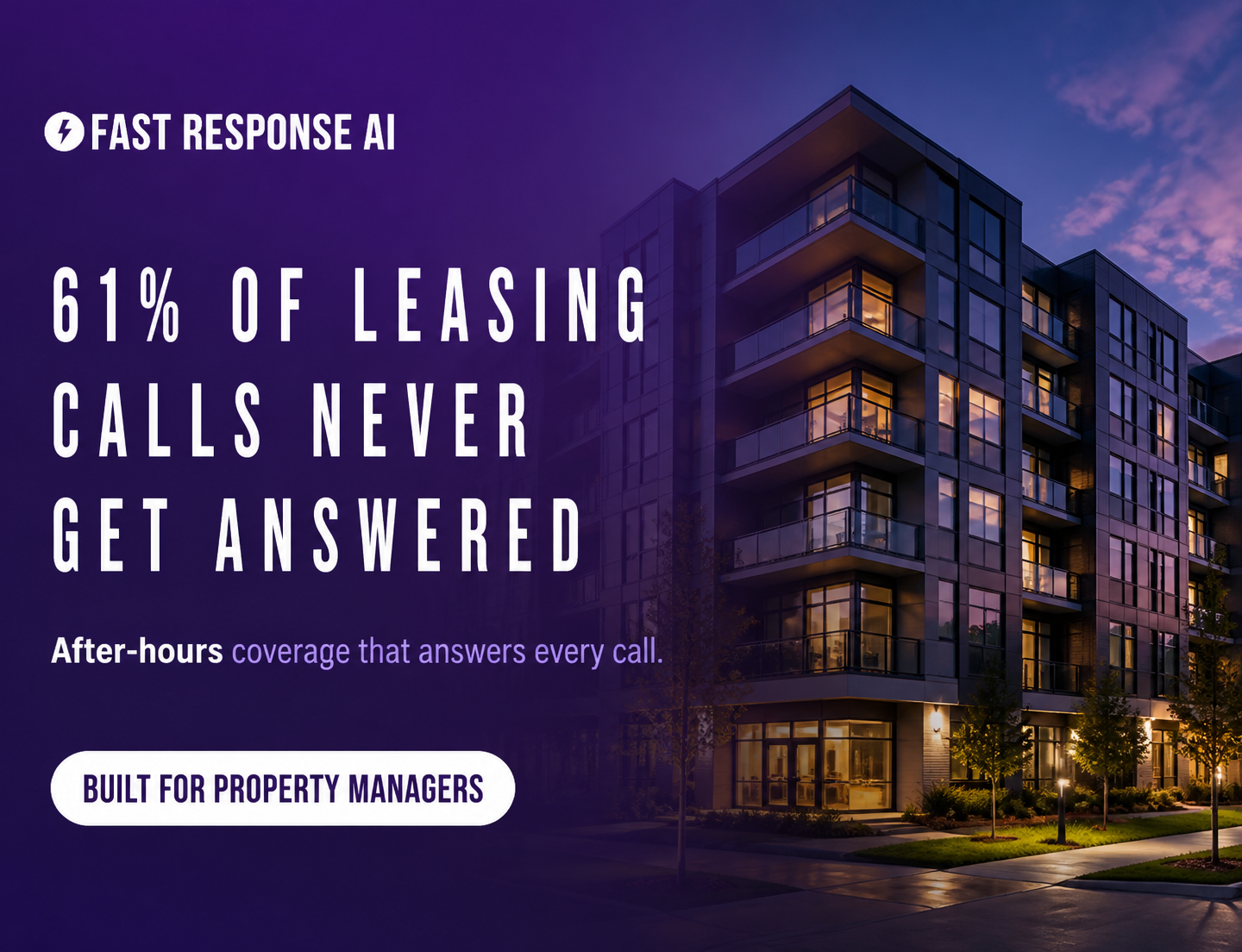
Across 170,825 calls to multifamily properties in a single quarter, 60.8% went unanswered. Not just the after-hours calls. All of them. If you are shopping for an after-hours answering service for property management, that number should change how you shop, because the lease you are losing is not only the 2am lockout. It is the 7:42pm tour request that rolled to voicemail while your office was dark.
An after-hours answering service for property management answers leasing and maintenance calls when your office is closed, so prospects and tenants reach a real response instead of voicemail. The best options also cover business hours, triage emergencies by rules you set, and bill at a predictable flat rate. Fast Response AI takes a different approach: you own the platform, you answer directly when you can, and an AI agent answers in your place when you cannot, with every call, text, and chat logged in one searchable place.
We answer phones for property managers running 150 or more units, in 29 languages, and here is the pattern we see over and over: the operator who buys after-hours coverage and keeps bleeding leases during business hours.
The 7:42pm Leasing Call Is Worth More Than Your 9am One
Picture last Tuesday. A prospect clocks out, eats dinner, opens Zillow, and calls about your two-bedroom at 7:42pm. Your office closed at 6. The call rings four times and hits voicemail.
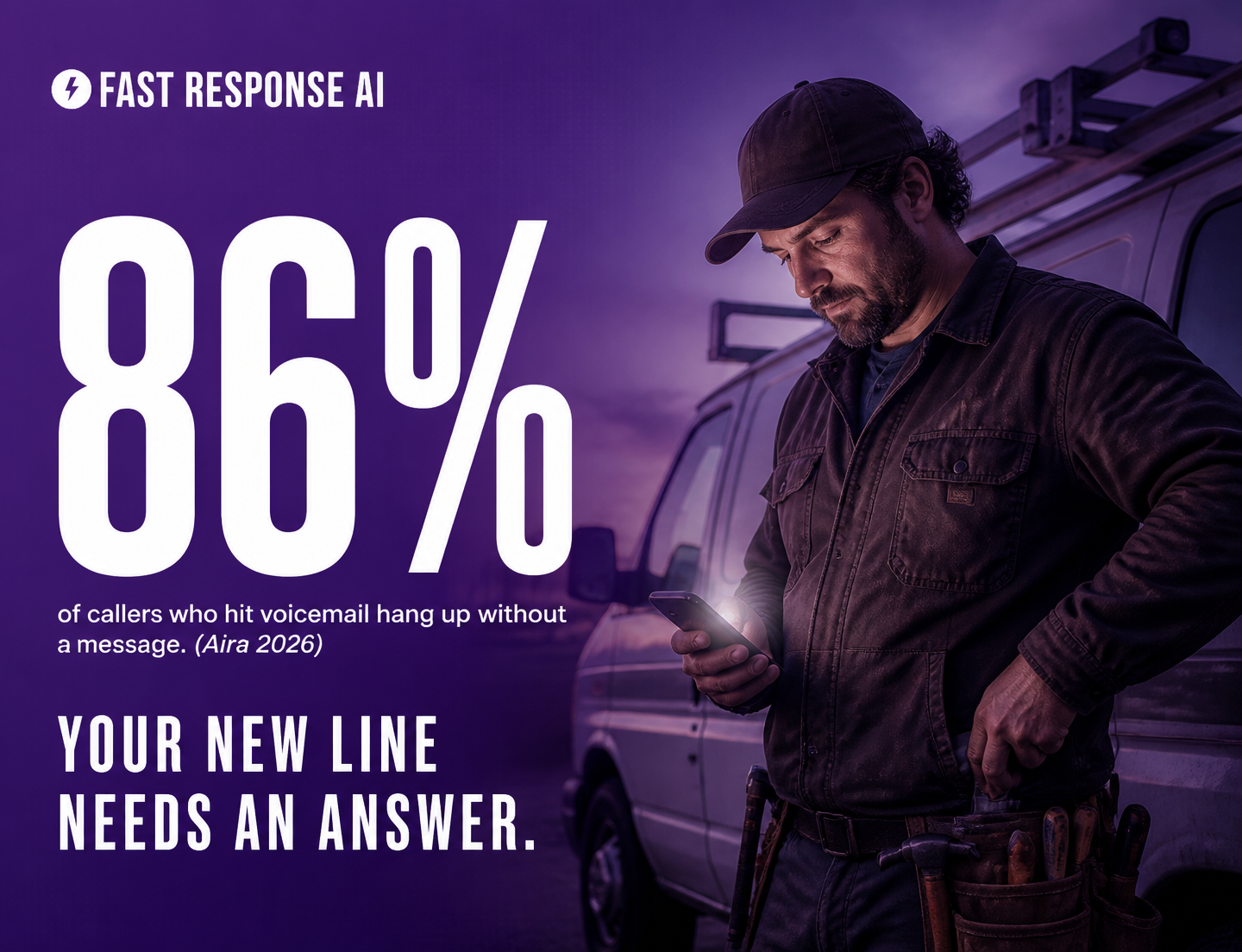
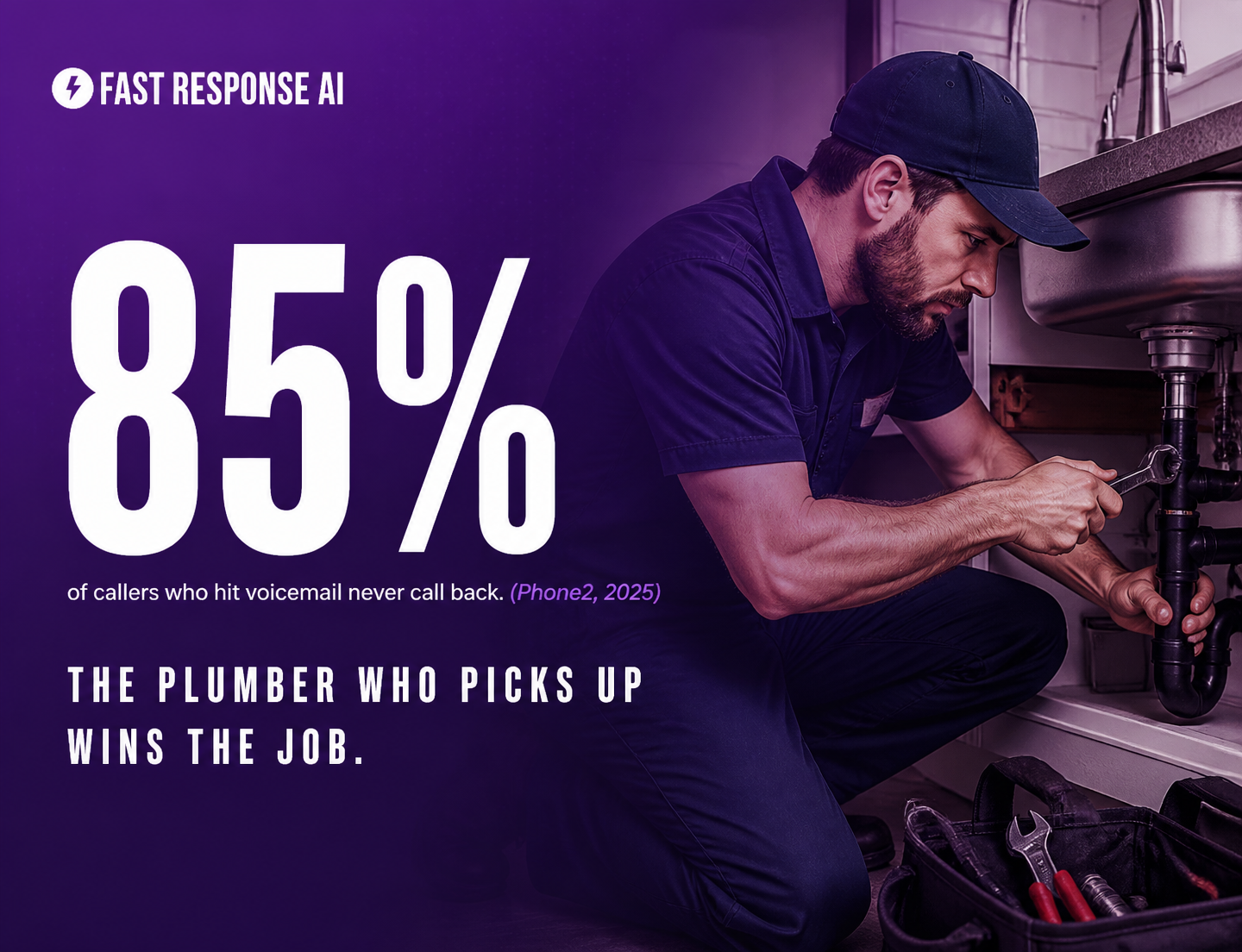
Here is what the data says happens next. About 85% of callers who reach voicemail never call back, and 62% of them call a competitor instead. That prospect is not leaving a message and waiting until morning. They are dialing the next listing on their screen while their phone is still warm. A prospect who gets an immediate response converts at roughly 15% to 25%. The same prospect who gets a callback at 9am the next day has already toured two other properties.
Now price that call. Depending on your market, a single missed lease inquiry represents $1,000 to $30,000 in rental income over the lease term. A 100-unit operation with normal turnover fields dozens of these calls a month. Miss a third of them, which is roughly what happens to inbound rental leads without round-the-clock response, and the vacancy math stops being about marketing spend and starts being about phone coverage.
Evening and weekend calls are disproportionately leasing calls, because that is when working renters apartment-hunt. Industry analysis puts 44% of rental inquiries outside normal business hours, in the evenings, on weekends, and on holidays when your leasing team is gone. Which means the calls you are structurally set up to miss are the highest-revenue calls you get.
What Most Property Managers Get Wrong About After-Hours Coverage
Here is the counterintuitive part: your after-hours problem is mostly a business-hours problem wearing a disguise.
That 60.8% unanswered rate was not measured at midnight. It includes Tuesday mornings, when your team is on-site for an inspection, mid-eviction-paperwork, or already on the other line. Property managers buy an after-hours answering service, feel covered, and never audit what happens to the 11am call when everyone is busy. The voicemail greeting is the same at 11am as it is at 11pm, and so is the no-callback rate.
If you take one sentence to your next ops meeting, take this one: most rental offices miss more leasing calls at 11am than at 11pm, and pay overage pricing for the privilege.
Here are the numbers worth putting in front of an owner or a board:
- 60.8% of calls to multifamily properties went unanswered, measured across 170,825 calls in a single quarter (Fiona, 2025).
- 44% of rental inquiries arrive outside business hours, when the leasing office is closed (Leasey.AI, 2026).
- 85% of callers who reach voicemail never call back (missed-call research aggregate, 2026).
- 62% of unanswered callers contact a competitor instead of trying again.
- Prospects who receive an immediate response convert at 15% to 25%, several times the rate of a next-day callback.
- Traditional property management answering services run about $1.30 to $1.49 per minute, with monthly plans commonly between $175 and $470.
- Only about 38% of inbound business calls are answered by a live person on the first try.
The second mistake is buying coverage priced by the call or the minute. Maintenance volume is spiky. One burst pipe in a cold snap and your coverage plan produces a four-figure invoice in your worst week. You end up rationing your own phone coverage during the exact weeks you need it most.
How a 150-Unit Operator Stopped Losing Leases
Our best customer runs about 150 units. Before switching, their setup was the standard one: office phones during the day, a legacy answering service at night, and a monthly bill that swung with maintenance volume.
The fix was not hiring. It was routing. They put Fast Response AI in front of every call, around the clock, and spent their setup time (under ten minutes to go live, then a bit more refining) on one thing: routing rules. Leasing inquiries get answered, qualified, and booked for tours in any of 29 languages, with no “para espanol, deje un mensaje.” Maintenance calls get triaged against the rules the manager wrote: the dripping faucet becomes a logged work order, and a genuine emergency like a gas smell pages the on-call tech immediately. Tenants with rent questions get answers instead of a callback queue.
The result is not really about technology. It is about what the operator gets back. They stopped being the company whose phone is a coin flip. Prospects reach a professional operation on the first ring at 7:42pm. The on-call tech’s phone rings only for real emergencies. And the owner stopped doing voicemail archaeology every morning at 7am, because nothing landed in voicemail.
That is the actual product. Not minutes, but the shift from “we will get back to you” to “we answered.” The manager stays in control the whole time: the AI captures the request, applies the routing rules, and notifies the right person. It does not dispatch outside vendors on its own, and there is no outsourced call center sitting between the manager and the tenant. Every conversation, from the AI and from the team, lands in one record the company owns.
What to Look For in an After-Hours Answering Service for Property Management
Most comparisons frame this as two choices: rent a live answering service or rent an AI receptionist. There is a third shape worth understanding before you sign anything.
| Attribute | Live answering service | Standalone AI receptionist | Owned platform with AI safety net |
|---|---|---|---|
| Who answers | Outsourced human agents | A bot that intercepts every call | You when available, your AI when you cannot pick up |
| Business-hours coverage | Usually after-hours only | Every call, but replaces you | Every call, with you staying primary |
| Pricing shape | Per call or per minute, spikes in busy weeks | Usually flat | Flat monthly base plus predictable overage |
| Emergency handling | Human takes a message, calls you | Varies, often message only | Triaged by your rules, pages your on-call staff |
| Call record ownership | Held by the vendor | Held by the vendor | Owned by you, one searchable log |
If you are evaluating options, human, AI, or owned platform, pressure-test four things.
Coverage window. Ask for their answer rate during your business hours, not just nights. If the service picks up only when your office is closed, you have solved 40% of the problem.
Emergency triage. The service must distinguish “no hot water” from “water heater flooding the unit below” and escalate accordingly, in writing, with a documented path to your on-call staff that you control.
Pricing shape. Per-call and per-minute pricing punishes you during storm weeks and leasing season. Prefer flat or bundled pricing so your worst week is not also your biggest invoice.
Language coverage. If your tenant base speaks Spanish, Mandarin, or Haitian Creole and your answering service does not, your answer rate is fiction for a chunk of your portfolio.
For a deeper breakdown of how this works for rental operators specifically, see our property managers page. If you also run field or maintenance crews, the same logic applies to trades on our contractors page, and there is more on missed-call economics on the Fast Response AI blog.
Frequently Asked Questions
Traditional live answering services typically charge about $1.30 to $1.49 per minute, with monthly plans often between $175 and $470 and per-call overages that climb fast in busy weeks. Named services sit at the higher end, for example Ruby starts around $235 for 50 minutes and Smith.ai starts around $292.50 for 30 calls. AI-based coverage runs far lower, with entry plans starting around $25 to $79 per month, and the flat pricing does not spike during high-volume maintenance weeks.
A good service answers leasing inquiries and books tours, triages maintenance requests, escalates true emergencies to your on-call staff, and answers common tenant questions about rent and policies. The best setups apply the same coverage during business hours, since a majority of missed calls happen while the office is technically open.
AI answers instantly on every call, costs a fraction of per-minute human services, and handles several calls at once during a spike, so a storm week costs the same as a quiet one. Live services can add human warmth on unusual, emotional calls, but they meter you by the call or minute and still place a third party on your line. Fast Response AI is neither an outsourced desk nor a bot that replaces you. You answer directly when you can, and the AI answers in your place when you cannot. There are no live agents sitting between you and your tenants.
Configured properly, the AI triages severity in real time against rules you write. Routine issues become logged work orders, and genuine emergencies like flooding, gas, or no heat in winter trigger an immediate page to your on-call technician. You define the escalation rules and the AI executes them the same way at 2pm and 2am. It captures the request and notifies your people. It does not decide to dispatch an outside vendor on its own.
It depends on the service, and this is the question that separates real coverage from a night-shift bandage. Most of the calls a property misses happen during open hours, when staff are on-site, on another line, or buried in paperwork. Ask any provider for their answer rate during your business hours, and prefer a setup that answers every call around the clock rather than only after 6pm.
Only if it is built for it. A large share of prospects and tenants are more comfortable in Spanish or another language, and a voicemail greeting they cannot act on is a lost lease. Fast Response AI answers, qualifies, and books tours in 29 languages, so a Spanish-speaking prospect at 8pm gets a real conversation and a scheduled tour instead of a message they will never leave.
Ready to stop being the operation whose phone is a coin flip? Start your free trial at fastresponse.ai. Live in under 10 minutes, no contract.