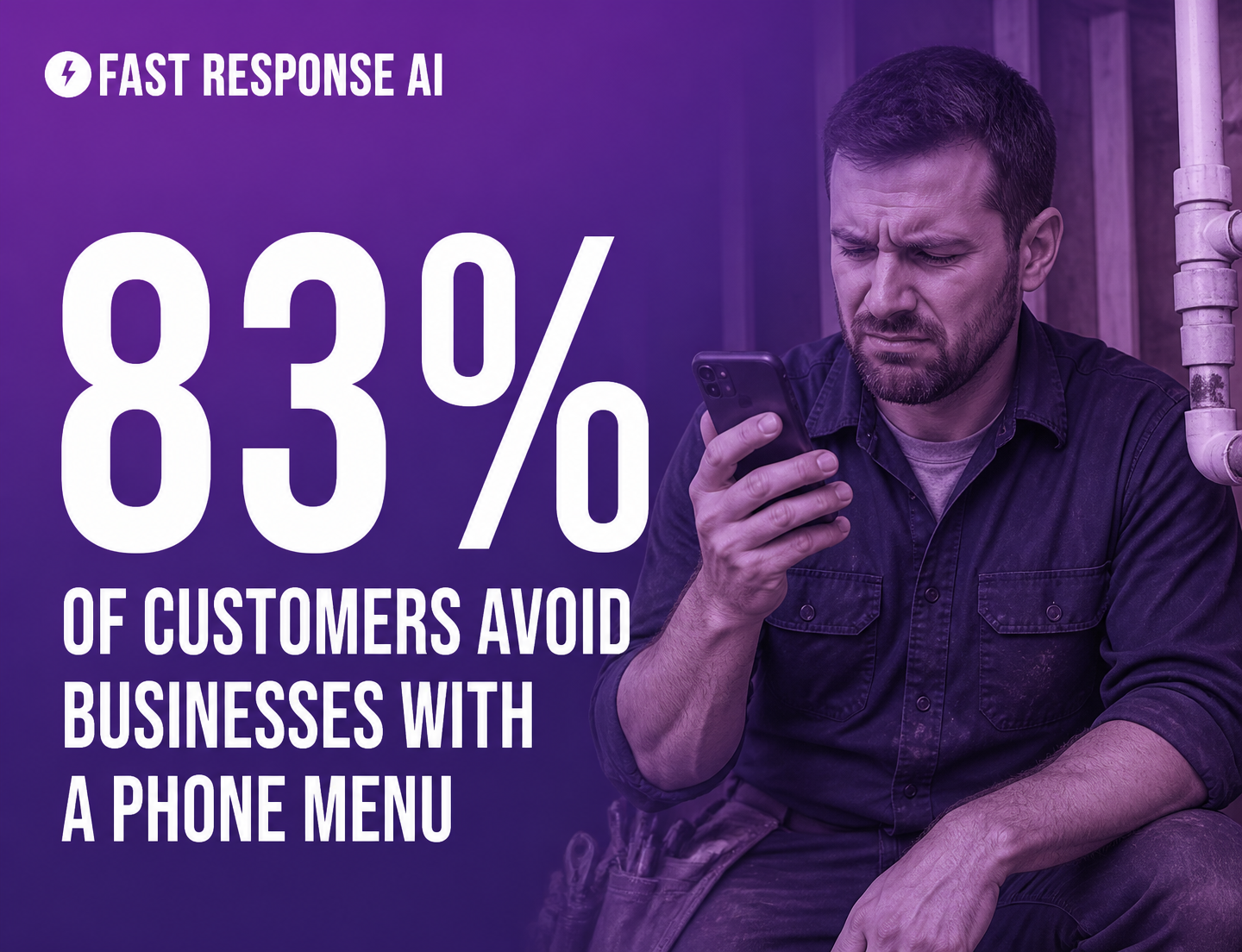
On average, people abandon 27% of calls the second they hit a phone menu, and 83% say they steer clear of businesses that still make them press 1, then 2, then 0. If an interactive voice response system is the first thing your customer hears, you are quietly training your best leads to hang up and dial the next number on Google.
An interactive voice response system is automated phone-menu technology that routes callers with keypad or voice prompts, the classic “press 1 for sales, press 2 for support.” It can route a call, but it cannot hold a real conversation or finish a task on its own. The modern replacement swaps the menu for conversational AI that answers in plain language, and in owner-operated platforms the call lands in an inbox you control instead of a phone tree your customer has to survive.
The phone menu was built for the company, never the caller
Picture the customer you actually want. A homeowner standing over a leaking water heater at 7pm. A prospective tenant who just saw your listing and wants to book a tour before someone else does. They are ready to give you money right now. Then your interactive voice response system answers: “For new service, press 1. For existing accounts, press 2. To repeat these options, press 9.”
That caller did not want options. They wanted a person, or at least a straight answer. So they do what most people do: they leave. Sixty percent of callers hang up inside the first minute, and over 90% are gone by minute five. The first 30 to 60 seconds is where you lose almost everyone, and a phone menu spends that exact window making the caller work.
It adds up to real money. One analysis put the cost of IVR frustration at $262 per customer, per year. For a plumber, an HVAC shop, or a property manager running on inbound calls, that is not a rounding error. That is the difference between a booked job and a one-star “couldn’t even reach them” review.
What most people get wrong about fixing their phone tree
Here is the part most business owners miss: the problem was never that your menu had too many options. You can trim it to three. You can re-record the prompts in a friendlier voice. It will not matter. In 2026, any menu at all now reads as one thing to the caller: “this business does not actually want to talk to me.”
That is the line worth pasting into your next team meeting. People do not hate your menu because it is badly designed. They hate it because a competitor a click away will let them just talk.
The numbers back it up:
- 83% of customers actively avoid calling companies that still use rigid phone menus when any alternative exists.
- Consumers say they have abandoned 27% of all calls specifically because they hit an IVR.
- 61% of consumers believe IVR creates a poor customer experience, per a Vonage study, and over half have abandoned a business entirely after one bad interaction.
- The complaints are consistent: 63% are about irrelevant menu options, 54% about never reaching a real person, and 45% about having to repeat themselves.
- Traditional IVR resolves about 12% of calls without a human. Conversational voice AI resolves roughly 73%.
- An IVR menu in 2026 behaves exactly like it did in 2019. It does not learn, it does not improve, and it does not care that your caller is in a hurry.
The last one is the quiet killer. A phone menu is frozen. It cannot get better, because there is nothing in it that was ever designed to.
How the operators who stopped losing calls actually did it
A property manager we work with runs 150 units. For years the after-hours plan was a voicemail box and a prayer. Tenants with a midnight no-heat call would leave a message, then call three other places before morning. She did not buy a fancier phone menu. She set one rule: after 6pm, route every call to her AI.
Now the late-night call gets answered in plain conversation. The AI asks what is wrong, captures the unit number and the issue, and drops the whole exchange into her inbox. She reads the full transcript with her coffee and decides what happens next, on her schedule. No tenant ever hits a menu. No tenant ever reaches an outsourced desk. They reach her system, branded as her, owned by her.
That is the model that replaced the phone tree, and it is worth being precise about what it is. Fast Response AI is not a phone menu and it is not an answering service that sits between you and your customer. It is a unified inbox for every call, text, and chat your business gets. You answer in real time when you can pick up. When you cannot, because you are on a roof, under a sink, or asleep, the AI answers in your place, in natural language, and captures the request so nothing rolls to voicemail. Every interaction, yours and the AI’s, lands in one searchable place you own. You stay in the conversation. The AI is the safety net, not the gatekeeper.
The sprinkler-repair operator who runs the whole thing solo, with no office and no staff, proves the point: this is not enterprise call-center software. It is infrastructure a one-person trade business can stand up in under 10 minutes and operate without anyone holding their hand.
IVR vs AI voice agent vs an owned comms platform: what actually differs
If you are weighing your options, here is the honest comparison. IVR still has a few legitimate uses, mostly security gates and single-action lines, so this is not “menus are evil.” It is “menus are the wrong tool for a business that lives on capturing leads.”
| What you care about | Traditional IVR | Standalone AI voice agent | Owned comms platform (Fast Response AI) |
|---|---|---|---|
| How the caller interacts | Keypad menu, “press 1” | Natural conversation | Natural conversation, or you pick up directly |
| Who the customer reaches | A phone tree | The vendor’s AI | Your system, branded as you |
| Channels covered | Calls only | Usually calls only | Calls, texts, and chat in one inbox |
| Who owns the records | Your phone provider | The vendor | You, fully searchable |
| You stay in the loop | No | Sometimes | Yes, real-time, you answer when you want |
| Typical cost | $15 to $150 per user per month, plus per-call fees | $99 to $349 per month | $79 per month base, 100 AI minutes included, flat overage |
| Time to set up | IT project | Onboarding call | Under 10 minutes, no contract |
The column that matters most is “who owns the records.” A menu hands your call history to your phone company. A standalone AI vendor keeps it on their platform. An owned inbox keeps every transcript, timestamp, and outcome in one place you control, which is exactly what a property manager needs for a lease dispute and what a contractor needs for a warranty claim.
If you run a trade business, the closest fit is built for exactly your workflow over on the Fast Response AI contractors page. If you manage rentals, the property managers page walks through after-hours routing. Either way, the goal is the same: kill the menu, keep the customer.
Frequently Asked Questions
What is an interactive voice response (IVR) system?
An IVR is automated phone technology that greets callers and routes them using a menu of keypad or voice prompts, like “press 1 for sales.” It can direct traffic and play recorded information, but it cannot hold a free-form conversation, answer an unexpected question, or complete a task beyond routing. That limitation is why so many callers hang up before they get where they are going.
Are IVR systems outdated in 2026?
For most small businesses that depend on inbound calls, yes. A 2026 phone menu works the same way it did in 2019, while 83% of customers now avoid businesses that still use rigid menus when an alternative exists. The exceptions are narrow: secure keypad entry, compliance-mandated flows, and single-action lines where every caller is doing the identical thing.
What is the difference between IVR and an AI voice agent?
An IVR follows a fixed script and waits for a button press. An AI voice agent understands natural speech, holds a two-way conversation, answers questions, and can capture or book a request end to end. In practice the gap is large: IVR resolves about 12% of calls without human help, while conversational voice AI resolves roughly 73%.
How much does an IVR system cost?
IVR is usually bundled into a cloud phone system at $15 to $150 per user per month, often with per-call fees, plus one-time costs like professional prompt recordings at $50 to $500 per script. By comparison, an owned communications platform like Fast Response AI starts at $79 per month with 100 AI minutes included and flat overage rates, with no contract.
Can AI replace my phone menu entirely?
For most inbound-driven businesses, it can. Instead of forcing callers through options, the AI simply answers, understands what they need, and captures it. You still set the rules for when the AI takes over, for example after hours, on weekends, or when you cannot pick up, so you keep control without making customers navigate a tree.
Do customers prefer a menu or talking to a person?
Overwhelmingly a person, or at least something that talks back. 54% of IVR complaints are specifically about never reaching a real human. The strongest setup keeps you, the owner, as the primary contact so you answer directly when you can, and uses conversational AI as the backup so nobody is ever dumped into a menu or a voicemail box.
When does an IVR still make sense?
A few cases hold up: pure security gates that require keypad entry, deeply regulated workflows where a fixed menu is part of compliance, and single-purpose lines where literally every caller wants the same one thing. Outside of those, a menu mostly just adds friction between you and a lead who is ready to buy.
Ready to retire the phone menu for good? Start your free trial at fastresponse.ai. Live in under 10 minutes, no contract.